Is the global economic crisis a manufactured opportunity for a "structural adjustment" of 1st world nations? Asere at Malcolm X Grassroots Movement (MXGM) explores the economic and human rights consequences in an essay entitled "The Hold Up."
Now that the financial bubble created by the big banks and Wall Street has burst, leaving people confused and disoriented from the shock, the "cartels" have succeeded in shifting the responsibility and consequences to taxpayers, nationalizing their debt/risk through passage of the unpopular 800 Billion bailout known as the Housing and Economic Recovery Act of 2008.
The big banks and investment companies created the financial crisis when they began the criminal practice of valuing debt/risk as assets and selling the bundled debt as "securities" to global investors. The current seismic financial shift will maneuver the affected communities closer to the financial condition of the world's poor majority, lowering their standard of living. The cycle of debt, dependency and indentured servitude is keeping the world enslaved to the global banking system (IMF, World Bank) that takes its orders from Washington and the other nations of the G7.
Many in the global north (North America, Europe, Scandinavia...etc) have no real concept of the conditions that exist in the global south, in the slums of Haiti, India, Philippines, Indonesia, Latin America, Africa... etc. Now the global North are realizing that they too are at the mercy of the policy makers who, aligned with the richest 1 percent are "centralizing" the global economy, consolidating economic power and redistributing the wealth. In the U.S. the target is the working class gains made during the decade following the October 1929 stock market crash; such as the social security act, the minimum wage, unions (National Labor Relations Act of 1935) and the 40 hour work week. "Today all these social and economic gains are under attack."1 So structural adjustment has come to the the U.S. and the global north.
Structural adjustment has been a part of U.S. policy in Latin America, the Caribbean, Africa and other "developing countries" since the 1950s. In Haiti the Clinton administration demanded as a condition of restoring Aristide to power (after a U.S. supported military coup) the implementation of a structural adjustment program -- to the detriment of the Haitian people.
For decades, two sometimes divergent, sometimes convergent streams of U.S. policy have played an influential role in defining the economic and political system of Haiti, the poorest country in the Western Hemisphere. Economic policy has steadily supported the interests of U.S. investors and exporters. U.S. political interests in Haiti have been less unified, careening between support for democracy and development and traditional U.S. collusion with the elites and the military. Too often, the interests of the Haitian people, who live in the poorest country in the Western hemisphere, have been sacrificed for the imperatives of Washington policymakers.
The failure of U.S. foreign policy is evidenced by the global financial crisis. And the feeding frenzy of these "gangstas" on the developing world's resources could not be stopped at America's shores. The U.S. controlled global banking system is now feeding on U.S. communities. The U.S. is in the process of becoming the "banana republic" that it has so long ridiculed in "developing countries," while supporting fostering the cruel system through its promotion of structural adjustment programs.
"The greatness of a nation is not measured by the height of its buildings or its steel output or its military might but by these three factors:
1. the rights and opportunities it extends all its citizens, especially the lowliest
2. the manner in which it absorbs and responds to the criticism of its citizenry and the world
3. the willingness and ability of its citizens to question and actively resist the propaganda of that nation's elites ... "
A pre- 850 billion bailout analysis of the American economic system written in February 2007 makes the point that we will change nothing unless we "change the way money works in our personal lives, our communities, and our world." The author Carolyn Baker credits Catherine Austin Fitts as the one person "on earth who has... clearly articulated the way sustainable and unsustainable economic systems work." Ms. Baker teaches history to college students and has written several books. She believes that US presidents have little influence and control over the American economic system, which she terms the "neo-liberal tapeworm" that feeds on its host (the U.S. citizen) and the world.
Naomi Klein, who wrote the book "The Shock Doctrine: The Rise of Disaster Capitalism." thinks that the current economic crisis and bail out is the "shock" that will prevent a president Obama from instituting the changes that his campaign is promoting; such as new sources of sustainable energy, universal healthcare, an overhaul of the education system and middle class tax relief.
"Tapeworm” is the name Fitts applies to the economic system of the U.S. which seeks to feed upon both its inhabitants and its neighbors, near and far, and at the same time, ingest them with toxins which cause them to crave the very elements which feed the Tapeworm, thereby establishing a perpetual search-and-destroy economic system. Inherent in Tapeworm economics is the primacy of centralized financial systems such as the Federal Reserve, national and worldwide banking networks, a complex global economic apparatus, reliance on agribusiness for food supply and distribution, and the privatization of resources—all without financial transparency or accountability.
Conversely, a sustainable economy is de-centralized and locally-focused, relying on small, well-managed local banks; food supplies which are grown, financed, and distributed locally; community ownership of land and resources; local commerce and industry; and above all, financial transparency.
Among the myriad advantages of categorizing economic systems in this way is the immediate exposure of federal election campaigns as unequivocally by, for, and about centralized financial systems which offer the illusions of “choice” and “change”.
No sincere proponent of a sustainable economy has the slightest possibility of emerging victorious in a country where centralized financial systems furnish, finance, and in the current milieu, manage electoral outcomes. Or as Aaron Russo’s documentary “America From Freedom To Fascism” underscored, voting in a national election is essentially making a choice between two crime families who are ostensibly at war with each other but will always join forces when their mutual interests are threatened.
Barack Obama has taken an active part in supporting the unpopular bailout of Wall Street to the tune of $850 billion dollars, so it should come as no surprise that the very same Wall Street firms to benefit from the bailout are the top five funders of the Obama campaign. OpenSecrets.org lists the top five Obama contributors as Merrill Lynch, Citigroup Inc, Morgan Stanley, Goldman Sachs and JPMorgan Chase & Co. The organizations themselves did not donate , rather the money came from the organization's PAC, its individual members or employees or owners, and those individuals' immediate families. Organization totals include subsidiaries and affiliates. The same top five contributors are listed for Senator John McCain.
Unfortunately, the bailout did not include measures to help middle class Americans; such as a moratorium on foreclosures, mortgage relief and restructuring and bankruptcy relief. The U.S. government is complicit in giving Treasury Secretary Paulson and his cronies on Wall Street a blank check and very little transparency and oversight to stop them from further theft and mismanagement. The very people who have exploited the system have been rewarded and are set to use this bailout as a windfall that will cover more risky investments and their assets.
The Baker article maintains:
If we attentively read United States history, we learn that particularly in recent times, financial systems, not presidents, dictate policy and that “Chief Executives” are themselves at the mercy of those systems--before, during, and after their term of office. Electing presidents changes little, but changing how money works changes everything.
Indigenous People Respond to the World Financial Crisis An article in the Mohawk Nation News uses the parasite analogy to describe the U.S. economic system and its precipitous collapse, suggesting the necessity for revolutionary change:
"The public is crying out for major change to end the colonial racist greedy system. They have to look at Indigenous culture and harmonize their society with ours to survive. They need to renew all their arrangements with us to live, think and govern themselves so that the parasites are pushed aside. Sacrifices are necessary or humanity will destroy itself.
There is another world, a world of resistance. Our fate rests in our own humble hands. Indigenous people have survived. We kept our philosophy, our notions of governance, our duties to mother earth and our way of life which was terribly damaged. We have been able to resuscitate it and bring it back to a healthy life. We all have our strengths. We have an enormous evolved consciousness. People are beginning to see through this capitalist fraud.
Do U.S. President George Bush, Republican candidate John McCain and Democratic candidate Barack Obama want to really re-arrange the economy and society on a new basis? Do they want to dig up the roots of the colonial past and harmonize relations with the Indigenous people and mother earth?"
Ms. Baker writes that the "neoliberal tapeworm" is also being rejected in Latin America in countries like Venezuela, Bolivia, Chile, Ecuador, and Nicaragua for more sustainable economic systems. In Brazil, Senator Eduardo Matarazzo Suplicy sponsored "Citizen's Basic Income" legislation. In their book "The Ethics And Economics of the Basic Income Guarantee", Karl Widerquist and Michael Anthony describe Brazil's basic income law. A citizen in Brazil has the right to a basic income and to contribute to that developing nation building "a just and civilized society." Interestingly, in the U.S., Alaska has a guaranteed income in the form of the "Alaska Permanent Fund" which provides a guaranteed income to all of Alaska's citizens. This economic instrument is also being introduced in Iraq as an oil shares "dividend" to be distributed to Iraq's citizens.
Ms. Baker theorizes that an economic transformation must take place in the United States in order for humankind and the ecosystems to survive beyond the age of oil
"It first begins with a commitment to financial literacy in concert with sustainable economics.
Next, one must increase one’s learning curve regarding the reality of corruption in the United States. American “exceptionalism”, the puerile illusion that other countries are corrupt, but the U.S. is not, must be shattered...
As a result of this recognition, it then becomes crucial to illuminate corruption and Tapeworm economics in one’s own community, i.e., narcotics trafficking, fraud, entities such as universities, foundations, churches, non-profit agencies, and media that accept contributions from the Tapeworm and serve its interests...
...we have no business depositing our money in Tapeworm banks or using credit cards from those institutions. It is our responsibility to transact with institutions that keep the money in our communities, rather than drain it out...
Understand that personal debt finances the Tapeworm and ensures its continued success. Get out of debt, and if you must use credit cards at all, pay them off in full monthly... Investigate people-to-people lending arrangements such as those found at www.prosper.com.
Become involved with other activists in your community to block the privatization of land and resources and demand public ownership of them.
Recognize that “socially responsible investing” usually isn’t. Consult the Solari website for investment opportunities that genuinely promote sustainability while bringing an optimum return.
Consider investing in precious metals—silver or gold, and consult the Solari site for ways to begin doing so with small, affordable amounts. If you deposit money in a savings account, why not invest some of it in precious metals instead?
If we attentively read United States history, we learn that particularly in recent times, financial systems, not presidents, dictate policy and that “Chief Executives” are themselves at the mercy of those systems--before, during, and after their term of office. Electing presidents changes little, but changing how money works changes everything.
Update 10.22.08 I have the wrong link for Barack Obama's top contributors. Obama's top contributors are here. I mistakenly have John McCain's top campaign contributors instead. I regret the error.
The US State Department and its surrogates go around the world monitoring the economies and policies of governments in order to see to it that industries are privatized and opened up to "free trade" mandates dictated by multinational corporations. However, in a move designed to get a handle on the slumping housing market, the US government has taken over the mortgage giants Freddie Mac and Fannie Mae. The Bush administration has been careful not to use the word, but its takeover amounts to “nationalizing” the two privately held businesses.
AFL-CIO chief economist Ron Blackwell says [watch video, below], "Housing prices are falling faster presently than during the Great Depression. This is very serious."
Don't expect US government funded groups like the International Crisis Group (ICG) (a "bevy of detached "intellectuals" that seems to think that they need to hold forth on all world issues") to report on the Bush administration's hypocrisy on the issue of privatization. Their report's "findings" are geared towards coinciding with the goals of the US State Department. And privatization (i.e. "making the world safe for American corporations") is a goal that is often at the bottom of US interventions into the sovereign politics of nations like Venezuela and Haiti.
VENEZUELA
"Large social service programs, termed “missions”, have been launched in poor neighbourhoods and helped gain popular support for the government. State control of the economy, not just the vital oil sector, has increased, as has pressure on opposition media and NGOs".
The report concludes: ...increase efforts to improve the medium to long-term sustainability of social and infrastructure programs by attacking inflation and fiscal deficits and avoiding excessive state control of the economy...
"He [Aristide] offered an explanation rarely heard in discussions of Haitian politics--actually, he offered three: "privatization, privatization and privatization."
"...Washington's negotiators made one demand that Aristide could not accept: the immediate sell-off of Haiti's state-owned enterprises, including phones and electricity. Aristide argued that unregulated privatization would transform state monopolies into private oligarchies, increasing the riches of Haiti's elite and stripping the poor of their national wealth.."
At the risk of sounding sanctimonious; the US must avoid "excessive state control," If allowed to "nationalize" industries, the US faces an increased risk of conflict. We must all work to "PREVENT CONFLICT WORLDWIDE." Even if we first have to see to it that preferred "opposition groups" are well-funded, represented and ready to step in and achieve "freedom" and "democracy."
This past Sunday 60 Minutes featured a segment called House Of Cards: The Mortgage Mess. "60 Minutes" Reports On How The Subprime Loan Crisis Is Shaking Markets Worldwide.
I was appalled by the way that 60 Minutes failed to point out that this crisis is responsible for the biggest loss of wealth for African Americans in modern US history.
"A startling new report has predicted the subprime mortgage crisis will cause people of color to lose up to $213 billion, leading to the greatest loss of wealth in modern U.S. history. The figure appears in a new report from United for a Fair Economy called “Foreclosed: The State of the Dream 2008.” The group accuses mortgage lenders of deliberately targeting the poor and people of color with high-cost loans."
Report: Subprime Mortgage Crisis Causing African Americans to Experience Greatest Loss of Wealth in Modern U.S. History
The subprime crisis is hitting hardest in black and urban neighborhoods and destroying the wealth of current and future generations of blacks who might become homeowners. Owning a home has traditionally been a way to achieve financial parity in this country.
Also, 60 Minutes fails to point out the structural problems inherent with a system where 1 out 4 subprime loans are expected to go into foreclosure.
"The latest statistics show US foreclosure filings nearly doubled in October from the same month last year. Nearly 225,000 foreclosure filings were reported last month, a 94% spike over October of 2006. And economists project the figures will only get worse in 2008, when some two million homeowners potentially face foreclosure when their adjustable-rate mortgages reset at higher rates.
African American and Latino homeowners have been particularly hard hit. A recent study by ACORN found that upper-income African Americans and Latinos were more than three times as likely as upper-income whites to have a high-cost loan."
Minorities Hit Hardest by Subprime Mortgage Crisis
I was appalled that this aspect of the crisis was never even given a mention and the emphasis was almost wholly on the loss in the global markets by speculators who were duped by Wall Street hucksters selling off the American Dream. The American Dream is worth just pennies on the dollar, under the inattentive gaze of the Bush administration, and as a result of the deregulation that began with the Carter administration; steamrolled with the election of Ronald Reagan and continued into the Clinton years and beyond. Reagan sure "changed the trajectory of America" and not for the better!
One troubling aspect of the piece was the racial dichotomy. My concern is for the unfair characterization of the black couple interviewed about their subprime mortgage. Whether it was intentional or not an unfair comparison was made. That the "dumb" couple who just did not understand the terms of their mortgage was the black couple and that the "savvy" couple who did understand, yet felt justified in "walking away" from the terms... seemed quite a stark comparison. Couldn't the 60 Minutes producers do better than that? It is an outrage that this is their idea of fair, unbiased reporting, if that was what they intended.
60 Minutes represents that there is no racial divide by ignoring the racial aspects of the subprime crisis. They did so by ignoring the people that it hits hardest. Then, to add insult to injury they present a false dichotomy with obvious racial overtones.
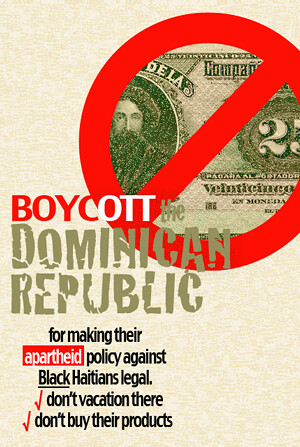
In the Dominican Republic dispossessed Haitians are under armed guard on plantations harvesting sugarcane, most of which ends up in US kitchens. Cutting cane by machete, they work 14 hour days, 7 days a week, frequently without access to decent housing, electricity, clean water, education, healthcare or adequate nutrition.
Link to full length movie here: The Price Of Sugar
HLLN in partnership to help transfer solar engineering skills to Haitian women. Solar power will make Haiti's rural women and urban poor less dependent on USAID/ UN /NGOs.
Support Zili Dlo's solar programs for clean water and generating power from the sun. Clean Water is life and HealthSupport Zili Dlo – Clean Water for Everyone in Haiti
Join our fundraising committee, or book an Ezili Danto presentation. Help Ezili's HLLN raise funds to finance education for Haiti's solar engineers and water trucks for more clean water delivery for our communities. Write to erzilidanto@yahoo.com.
****************************************************
Haitian Lawyers Leadership Network
The Seizure of Haiti by the US: A Report on the Military Occupation of Haiti and the
History of the Treaty Forced Upon Her
Issued by The Foreign Policy Association
Endorsed & distributed by The National Popular Government League - April 1922
"Hearings before a Select Committee of the U.S. Senate pursuant to Senate Resolution 112, authorizing an inquiry into the occupation and administration of the territories of the Republic of Haiti."
You may use, publish, distribute, link to my articles provided that you respect copyrights. My name and that of this blog must be mentioned at all times.
Haitian Peasants Against Monsanto
A large demonstration of at least 10,000 farmers had occurred in central Haiti on Friday, June 4. organized by "Mouvman Peyizan Papay" or MPP, the peasants and a contingent of youths from the capital marched for three hours to the town of Hinche to protest the American multinational company Monsanto and demand the burning of 475 tons of roundup ready genetically modified seeds the company was trying to "give" Haiti.

 Is the global economic crisis a manufactured opportunity for a "structural adjustment" of 1st world nations? Asere at Malcolm X Grassroots Movement (MXGM) explores the economic and human rights consequences in an essay entitled "The Hold Up."